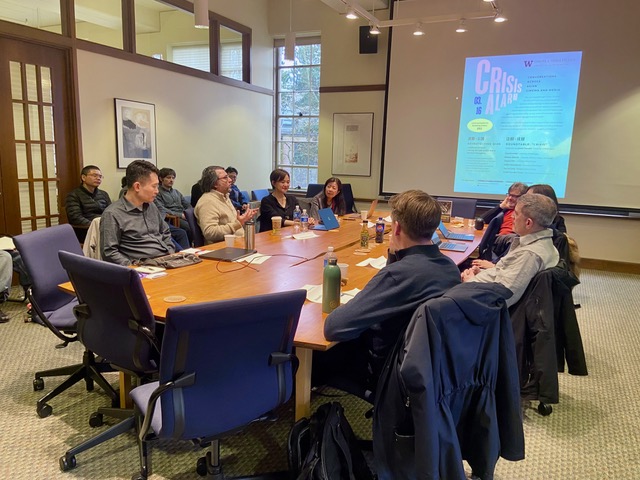
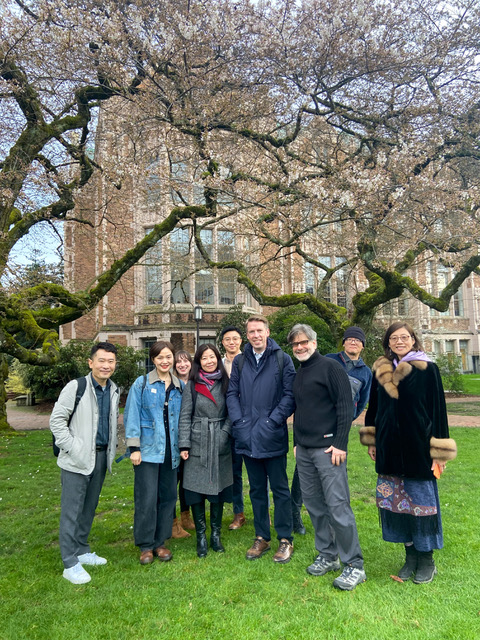
The graduate student–organized conference, Crisis Alarm: Conversations Across Asian Cinema and Media, was held at the Simpson Center on Monday, March 16, bringing together scholars working across diverse regional contexts in Asian cinema and media. The one-day event featured a keynote address in the morning followed by a roundtable discussion in the afternoon. Across their presentations, participants reflected on how “crisis” shapes both their objects of study and their methodological approaches.
Keynote speaker Ying Qian (Columbia University), a scholar of Chinese documentary media, examined the contemporary moment of war as a condition of crisis. She introduced a film produced in wartime China in the 1940s, notable for its casting of Japanese prisoners of war, and used it to explore filmmaking as a practice grounded in trust under conditions of extreme uncertainty.
The afternoon roundtable brought together Belinda Qian He (University of Illinois Urbana-Champaign), Kristof Van den Troost (The Chinese University of Hong Kong), Tze-Lan Sang (Michigan State University), and University of Washington faculty members Yomi Braester and Sudhir Mahadevan (Cinema & Media Studies), along with Ungsan Kim (Asian Languages and Literature). Their discussion foregrounded the multiplicity of crises, ranging from representation of crisis to material challenges, including archival inaccessibility and declining film attendance. At the same time, panelists emphasized the generative potential of crisis as it can prompt new questions, and, at times, enable unexpected methodological openings.
The presentations prompted lively engagement from the audience as they picked up these threads by extending the conversation beyond individual projects to larger reflections on the direction of cinema and media studies as a field.
The event also fostered dialogue between cinema and media studies and area studies, which underscored the breadth of regional expertise within the CMS department. Just as importantly, it exemplified the department’s strong tradition of graduate student–led initiatives, which continue to shape a vibrant and collaborative intellectual community.
—Runjie Wang