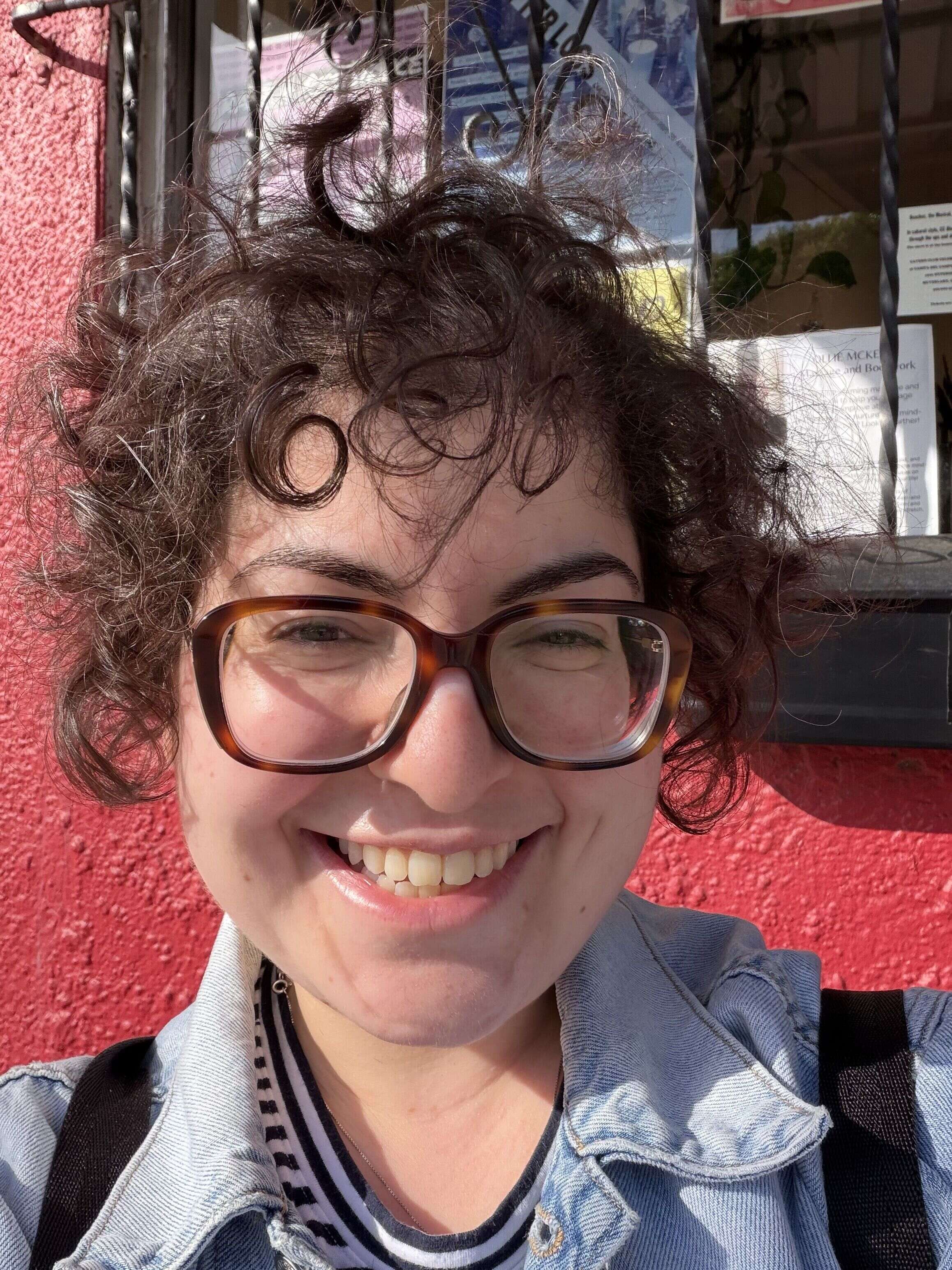
With your experience double-majoring in Classical Studies and Comparative Literature Cinema Studies at the UW, how did these fields influence your career path?
I started out in Classics, and then pivoted to Film, an area of study that lived in Comparative Literature at the time. When I first started college, I loved Shakespeare and wanted to understand the Latin that inspired his plays, so I decided I was going to dive deeply into Classics. I was very focused on that. And I was in the honors program.
Then, in my sophomore year, I took a summer class with Ted Mack on Japanese cinema. That class made me realize that A) there was this thing called being a “film major,” and B) I was very interested in pursuing that. What that class showed me was not only the power of film as a narrative tool, but it introduced me to multiple ways of seeing the same set of events. It struck me that film could provide me with two stories simultaneously, of course, depending on who is telling the story – for example, the American and Japanese experiences of the aftermath of World War II – depending on how the narrative is being crafted. Those two stories could stick with me equally.
I thought, “Well, I want to understand that [narrative structure] better, critically and creatively.” So, from there, as I continued my Classics degree, the next year, I declared film. I took intro classes with Eric Ames, [Andrew Nestingen,] and Jennifer Bean, who [Dr. Bean] would go on to advise my [honors] thesis. I believe both [Drs. Ames and Bean] have inspired the way I study film as an incredibly visceral, intellectual, and emotionally powerful experience. From the beginning, the classes I took at UW invited me to think about the connections between language, storytelling, and more broadly philosophy. Having studied linguistics and language models as deeply as the Classics major [at UW] invites you to do, this Classics background [specifically Latin and Greek] still informs my fiction writing and my academic scholarship.
Ultimately, both [Classics and film studies] contributed to the theory and methodology I wrote about in my doctoral dissertation at USC. My dissertation was focused on the study of the experience of documentary film. One of the things that is difficult to describe in any language is this intangible thing called experience. I used my Classics background to think about what language we have historically used, both philosophically and in terms of these different etymological lineages, to talk in precise ways about the experience of film viewing.
What motivated you to pursue documentary studies specifically?
When I was in the program [at UW], guest lecturers would come in, and one of those speakers was Michael Renov from USC. He showed some clips which had these – this is going to seem very unrelated to documentary, but it will circle back – they had these colored backgrounds that were yellow and black, which I found odd when looking at the examples. After the lecture, which, more broadly, touched on documentary interview aesthetics, he invited questions. I asked, what was the intention behind using different colored backgrounds? I expected him to give me a brief, two-word answer. Instead, he engaged me for a fair amount of time with questions like, “why did that draw your attention? What inspired you to think about things that way?” And we had a great conversation about how documentary aesthetics can lead us to understand truth in different ways through the visual and formal cues in nonfiction film. I have always been interested in how we think about truth, and how, in media, truth is visually represented, both as a visceral experience and affective experience.
It was a conversation that made me think about a pedagogical methodology, a way of teaching: of meeting people where they are, inviting them into the conversation. Instead of implying, "hey, I'm the person who is preeminent in this field, and therefore I am the authority,” the approach was, “I'm going to have a dialogue with you.” I came away thinking, not only is this a really interesting field, but that is the kind of teacher and that is the sort of academic I want to be. It was an approach to learning and the discipline that inspired me to pursue my present line of study.
You mentioned that you were engaged in game design and film studies writing as well. How did you integrate those disciplines into your research?
I integrated them in two ways, as a medium to be used as a teaching tool and as content to be studied. I think about my scholarship in terms of, “how could this [game design and its content] be used as a teaching tool to bring people into a conversation?” Game studies seemed like a really great way to do that, specifically when I was working on my dissertation about representations of truth and veracity and how we come to understand narratives about history.
Narrating history is kind of like a choice-based narrative game. Both begin with sets of facts. All of which, you know, are valid and validated. But you can choose to connect them in different ways depending on the personal and cultural context which informs you and the time in which you are writing. We can conceive of history as a story with elaborate branches in the way you would design a choice-based narrative game with drop-down menus of options that are informed by prior experience that then inform later experiences.
I use this approach to teach how to create historiographic texts, as an example of content to demonstrate and model what I abstractly introduce in my dissertation. Each time I analyze an example of media and philosophically discuss the experience of viewing nonfiction films, I specifically look at representations of truth and at understandings of veracity. And then I offer a playable prototype to model these concepts. That continues to be my goal and how I think about my scholarship in terms of balancing the theoretical with the practical.
And you shared a bit about your work on horror gaming interfaces in relation to disability. What inspired this focus on those topics specifically, and what do you hope people will take away from it?
Inspired by a couple of things, I had been writing about horror gaming in my dissertation. The research had a component about visceral truth and the idea that your body does not know the difference between something that you react to viscerally that is based in fiction and something that you react to viscerally that is based in fact. Your body still could have a sense memory or a powerful experience of resonance with something, whether it be fact or fiction. Consequently, I explored how these reactions related to our experience of nonfiction media.
Included in my range of the study of interactive experiences, I engaged with the horror genre. I found a wide range in how playable these games were, specifically for someone like me who has nerve damage in my hands. I observed that my reaction time was different in these games than another player’s reaction time who does have nerve damage, and that this difference might contribute to my having a different experience. This difference changed the way I played and thought about what is expected of me in these games, strictly based upon how they are designed. This adjustment possibly differentiated the visceral truths I formed when I played these games. As a result, I wanted to investigate this phenomenon further. I was engaging with these survival games, where I simply could not survive.
I was thinking, what does this mean more broadly in terms of what kind of behavior is rewarded [a quick and painless exit] and punished in these games? If a player’s objective is to experience the horror that is built into the design of the logic, what does it mean that the punished behavior results in this desired outcome – the horrific experience which includes violence, slasher-y, and gore – but also makes it so the games cannot be completed?
Based on this paradox and contradiction, I worked on an article, “Horrible Haptic Navigation,” forthcoming from The Disability and Horror Handbook. I also am exploring designs that offer alternate interfaces that are less monolithic and provide multiple more accessible gameplay paths. Multiple ways to survive, because even with accessibility features, games often assume a single, playable, worldview and narrative. These designs critically exemplify the interests that motivate this research and my teaching.
What is your experience like teaching such an interesting variety of courses? And are there any memorable moments or challenges you've faced in the classroom?
It has been a really wide range of experiences. Some classes I was given, such as, an intro to film history. Even in this case, I was provided a broad idea of the department’s objectives and the freedom to choose which media, including rare and non-traditional films, I wanted to show. I also included everyone’s greatest hits, so that students would view both the classics, as well as content they maybe would not see otherwise. Often, these were the larger history classes, where I presented material in a lecture format, more structured, each week introducing key terms and building upon course themes.
Then there were the courses I did design, particularly in my postdoc, which were “Age of AI” and “Queer-ing Media,” on queer media and adaptation. Those arose from two differing interests: new media and the infusion of artificial intelligence as an element of media content as it relates to our experience of truth. The latter grew out of my research and the former from looking at studies of experience from a queer phenomenological perspective through the lens of adaptation. Both classes were small seminars, so much of that experience was discussion-based.
When I was designing these classes, I thought about the narratives I wanted to introduce in the first class. What were the initial questions a student might ask in terms of how we think about adaptation or how we think about AI? These then we would explore in subsequent meetings, expanding upon our understanding in week five, week ten, week fifteen. At the same time, I gave students opportunities to bring in their own materials and discuss those materials. Those were conversations I enjoyed facilitating.
A memorable moment happened when I was teaching a documentary course and introduced, from work I explored in my PhD dissertation, a game design component. We were talking about studies of experience, and the topic for the week was, “how do you think about documentary as an experience?” More abstractly stated, “What does it mean to reconceptualize the viewing of content – an object, person, place, or event not as object, person, place, or event; instead as an experience that we are having as we are viewing? And what language can we give to that?”
To illustrate this, I had students design small games, small written interactive fiction projects, which modeled the philosophical process of describing experience, a concept central to phenomenology. Honestly, I had no idea how this exercise was going to go. I knew it was a weird assignment. What turned out was fun to watch. Students got very silly with this project, and, at some point, realized the philosophical process I had conceptually introduced to describe experience. “How do I ascribe language to experience, and what is soma, noema, and gnosis [our three key terms, defined as], the thing, the body and the resulting experience. And how do I apply that to something very concrete?” After turning theory into practice, a week later some said, “Hey, I was watching this movie, and I was thinking about gnosis, this concept that I would not have thought was relevant to my life a week ago, but now I see as this term we can use to describe experience in almost anything that we view.” It was rewarding to see students apply philosophy outside the classroom in an unexpected way.
As for a challenging moment: I did my dissertation in documentary and was asked to teach a documentary class right out of grad school. By the time I went to teach the subject for the first time, I had been thinking about the documentary form for seven years. And, as the obligation of every PhD candidate, I had posed a theory that is accretive to the field. So, caught up in my new, non-traditional approach to the subject, during the first meeting, I introduced visceral experience and referenced media that traditionally is regarded as fiction. Its unconventional inclusion was met with much confusion. Of course, it all made perfect sense to me. However, what I failed to account for was, on day one most people do not think about documentary media in this way. Looking back, I asked myself, “why didn’t that work the first time? What could I do differently when I taught the class again?”
The second time I taught that course, I started with a question-based format. “How do we think about documentary?” I began with a common understanding of this term. It wasn’t until we all were firmly grounded in what we were all watching, how we were experiencing what we were watching, and how we could talk about what we were watching, did I introduce an abstract and philosophical perspective, one explored in my dissertation. To this day, it continues to be a challenge to figure out how best to bring students into that conversation, to find pedagogical approaches that recognize multiple learning styles and student experiences. I learned a great deal from teaching that class. Subsequently, this is a subject I love to teach and explore with my students, one that I have refined over a few different iterations.
With teaching in the era of AI and interactive media's evolution, how do you see the future of media studies developing?
That is a big question. I think the difficulty I am having answering this question is actually part of my answer. AI as a tool aggregates information. It draws upon what has been written before or created before and makes something new out of it. Therefore, because AI only can reference prior content or itself, I look to a contextual model in terms of my analysis as it relates to a redefinition of documentary media. When we look at an AI image, we are referencing every image it has ever seen. This applies to non-AI images, as well. Everything AI creates is viewed in context. Nothing is original. Its truth has no point or single resource to reference. With content generated by AI, its authenticity is not verifiable. Being much less confident in the source, the determination of its veracity must be judged in context.
Media studies is a capacious discipline right now because content can be anything derived, from the AI slop many of us engage with every day on our devices of choice to subject matter including physical mediums such as traditional film or images recorded based on credible sources. Because the content that we recognize as nonfiction media can encompass so many things, I think about the field of nonfiction in terms of how we process this content and less about what form this content takes or the platform upon which we engage with its form. I think about the ways we experience this media. I believe that is one future direction the study of documentary and other media forms will take.
Do you have advice to give to current students interested in pursuing careers that are similar to your own?
I think the first advice I would give is, and maybe this is a cliché, but “be curious.” Many of the things I discovered, many of the intellectual and creative and career paths I chose, came about because I either was having a conversation with someone, or because I was curious and open to something I would not otherwise have thought about. If I had not talked to people, learned about their careers, learned about what they were interested in, I would not have thought about film studies as a career path. If I had not taken a couple of the classes I took at UW as an undergraduate and later at USC in my graduate program which combined theory and practice, I would not have thought of teaching film as something I could possibly do.
In a lot of cases, I met someone who was doing something that was kind of like the thing I was doing, or something I thought was cool or different or that I might like to do, and then asking questions like, “how did you get here?” But also, “what's kind of possible within that realm – within your subfield, like theory-practice, or documentary studies? What's possible within methods of teaching?” The advice I would give is find people who are doing things you are passionate about.
I had a lot of great conversations with Jennifer Bean. [And before that,] if I had not thought, “oh, maybe Japanese cinema is something I would like to learn more about,” I would not have arrived at film studies today. Specifically in academia: wanting to teach, but also doing this combination of teaching, writing, criticism, is somewhat idiosyncratic. I would ask myself, “what is an experience at a teaching or research focused institution like? Even if I am going to be in academia broadly, what kind of academia do I want to be in?,” which, again, is something I would not have figured out unless I had talked to people who are in different iterations of this career, at different kinds of schools. It helped me understand that an academic position does not look like just one thing and what version of that profession is going to be right for me. The faculty at UW and USC exemplified professionals who help me see what good teaching looks like. The final step was to decide the version that met my goals.
Did you always know you wanted to teach?
I don't know if I always wanted to teach, per se, but I always knew that I wanted to be in a profession that involved having conversations with people, particularly as someone who primarily communicates with the world through writing. I wanted to figure out how the ideas that I was thinking about creatively and academically are going to apply to people's lives in a concrete way. In terms of the teaching focus, everything I was thinking about was as a teaching tool. It always was in the back of my mind, “how would I use this to start a conversation? How would I prompt people to have a dialogue?” I view ideas as conversation starting points. How can I make this thought accessible, the place to start a dialogue.
Teaching was always something that I knew I enjoyed. It began with my first experience as a teaching assistant. Then, when I had a chance to lead a class for the first time, I knew it was a forum that would foster those conversations that would be a productive channel for my research and scholarship. I think there were teachers who definitely inspired me. In film and media studies, I experienced those moments in Jennifer Bean's Eco Cinema class, and then again in the Intro Class I took with Eric Ames [and Andrew Nestingen]. Each faculty was a great example of how to teach film that enforced, “there's a way to do that's going to be exciting, that's going to be hopefully inspiring, that's going to be applicable to the world more broadly, as well as specific to this thing called media.” Because film is a reflection of how we see our world, I am excited to be in a profession where I can have conversations with people about media literacy.
Besides your professional pursuits, you mentioned that you enjoy running and writing romance novels, which I love. Would you ever want to turn that into a career or keep doing it for fun?
As far as running, I am not nearly fast enough to do that professionally. I view my creative writing as a different way of engaging with the world. It definitely is something I see as a different way of engaging my brain, of keeping balance in my life, and a different way of engaging with adaptation and genre studies. The romance reading and writing community also is just a fantastic group of people. I have had great conversations there, and I find that really rewarding. In terms of a career, it is a passion of mine. I like approaching the world through a different lens with my writing, exploring that creative side. I am delighted when people read the things that I have written and when they respond, when these works prompt conversations. It is very much a hobby.
Any movie recommendations?
Recently, I have been watching a lot more TV than movies, which maybe is a very boring answer to that question. I think the last [new] movies I saw were really the Oscar-nominated round of films. I have been enjoying a lot of romance adaptations, though, and I have been comparing Heated Rivalry and Off Campus recently, which has been a rich experience in terms of adaptation, a through-line that encompasses so many of the themes I think about. It is an interesting experience to see the page-to-screen process, and I have enjoyed seeing the commentaries on both series.